
Does Working from Home Have a Positive Impact on Your Work/Life Balance and Help Develop Resilience?
76% of hybrid workers cite improved work-life balance (Gallup 2023), and our own research found 70% of highly resilient people enjoy a good work/life balance — but only if they set boundaries, which 52% of highly resilient people manage to do.
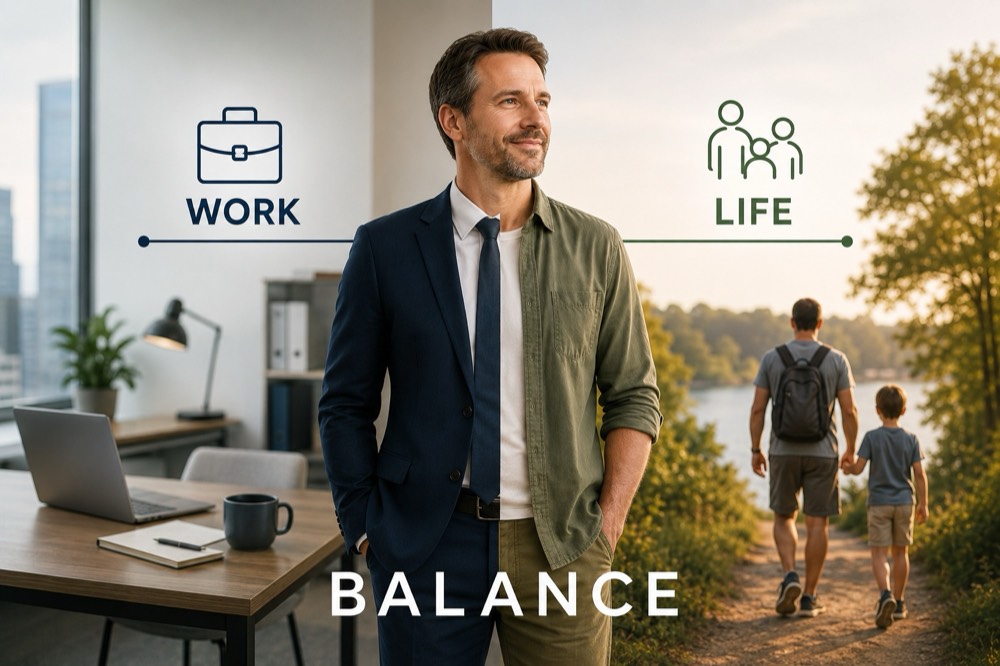
One survey carried out in the USA on the benefits of working from home revealed the top benefit to be ‘no commute’, closely followed by ‘flexible work schedule’ (WFH Research, 28,000+ working adults in the USA, 2023). In another survey, 76% of hybrid workers cited improved work-life balance, and many reported reduced employee burnout and higher perceived productivity (Gallup 2023). Teams with a formal hybrid collaboration plan are 66% more likely to be engaged at work and 29% less likely to be burned out (Gallup 2023).
Our own research
Our recent research in the technology sector shows that 70% of people with high levels of resilience enjoy a good work-life balance. Of those, 72% exercise regularly, and 98% have a well-established network of friends, family, and colleagues — important characteristics of highly resilient people.
Fully remote or hybrid working may be one way of achieving a better work-life balance. However, to ensure you manage to separate work from home, ensure that you set boundaries — 52% of people with high levels of resilience are able to separate work from home.
The current state of home and hybrid working
The work-from-home revolution continues, with nearly 30% of work in the US happening at home in the first half of 2023, a significant increase since 2019 (Stanford University 2023). A Gallup survey the same year found 52% of US workers worked a hybrid model, whilst 26% were fully remote, and 21% worked fully on-site.
In the UK, in February 2023 the Office for National Statistics reported 16% of working adults to be fully remote, 28% hybrid, and 56% office based — in London, 40% were hybrid workers. By June 2023 the proportions were 10% remote, 29% hybrid, and 61% office-based (Forbes UK). Workers aged 16–24 continued to be the group most likely to travel to work (79%), with the highest rate of workers without the ability to work from home; those aged 34–44 had the lowest rate of office working at 48%. Globally the percentage of employees working primarily from home reached 28% in 2023 (Statista). WFH is most prevalent in Technology (average 2.39 days/week), Finance (2.19 days), and Professional Business Services (1.95 days/week).
What the surveys say
According to the ONS 2022 survey, 78% of hybrid workers said working from home gave them an improved work-life balance, whilst ‘fewer distractions’, ‘quicker to complete work’ and ‘improved wellbeing’ were the next highest (53%, 52%, 47%). The highest-scored disadvantage was ‘harder to work with others’ at 48%, and 31% saw no disadvantages. The ONS 2021 survey had also found improved work-life balance to be the top advantage of working from home.
Analysis by WFH Research of the Survey of Working Arrangements & Attitudes (SWAA) 2023, a monthly online survey of 2,500–10,000 US residents aged 20–64, found the top benefits of working from home were no commute, a more flexible work schedule, less time spent getting ready for work, more time spent with family and friends, a quieter environment with fewer distractions, and fewer meetings. Employees had more time in the day for exercise (42.3% WFH vs 30.8% office-based), chores, caring for children and parents, and running errands. Workers self-assessed their increased efficiency working from home, ranging from 5% more efficient (one day a week at home) to 15% more efficient for those working five days a week from home.
A 2023 survey by Buffer of 3,000 remote workers worldwide found the benefits of WFH to include flexibility in how time is spent, flexibility to live and work where they choose, more diverse career options, more time (no commute), and better finances. 70% found it easier to do focused work, 65% found it easier to manage stress, and 75% said they feel connected to their colleagues. Worldwide, 61% of workers have a ‘very positive’ view of remote working, and 97% would recommend it to others.
Downsides included: 71% say it is very important to set work boundaries but had limited success; 81% check work emails outside work hours, including 63% at weekends and 34% on holiday; 48% frequently work outside contracted hours; 44% worked more in 2023 than 2022; 22% say being able to unplug is their biggest challenge; 45% do not have a dedicated office space at home; and loneliness and being at home too much were the biggest struggles. Not everyone wants to work from home — 40% of workers aged 50 and above prefer full-time remote work, whilst 75% of workers in their twenties want to spend time in the office.
A 2024 large-scale workplace review found working from home was associated with high levels of work-life balance, and allowed people to eat more healthily, feel less stressed and have lower blood pressure, along with better time management and improved work-life integration. However, remote workers are also more likely to snack, drink more and gain weight. The study found that maintaining a good work-life balance depended on factors such as setting boundaries, having a routine, and taking adequate breaks, and recommended providing staff with resources and guidance on maintaining their mental and psychological resilience (Hall et al, 2023).
The employer’s view
The SWAA 2023 survey found US employers would prefer staff to be in the office 2.75 days a week, whilst employees preferred 2.25 days. In 2023, tech giants including Google, Apple, Meta, Amazon and Microsoft implemented mandates requiring employees to be in the office at least three days a week, citing effective collaboration and maintaining organisational culture as their top concerns; 21% of employers reported employee resistance leading them to review the policy.
Remote and hybrid working is a fundamental shift in how we work, facilitated by the digital revolution and accelerated by the pandemic, and many CEOs have acknowledged that hybrid working is here to stay. A study by King’s College London found productivity across one multinational organisation increased by 10.5% when remote working was introduced during the pandemic, and the fully remote model has been maintained ever since (KCL 2025 study of 3,500 employees, Tempo BPO, UK) — though initial training was more effective when carried out in person. Despite this and similar evidence, trust gaps remain: only 54% of managers strongly agree they trust remote employees to be productive, and only 57% of employees strongly agree they feel trusted (Gallup 2023).
For employers, improved staff wellbeing, decreased overheads and increased productivity were cited as the most common reasons for using homeworking on a permanent basis; an earlier 2012 study showed hybrid working increased productivity by 13%. The ability to recruit from a wider talent pool, match jobs with skills, and reduce sickness absence were also cited as benefits (ONS 2021). Successful remote/hybrid working requires the right culture, shared vision and values, trust, output-based management, and flexibility.
How working from home can improve your work-life balance
- Flexible scheduling — working from home often allows more flexibility to adjust schedules around personal commitments, family, exercise and hobbies, resulting in a more balanced lifestyle.
- Reduced commute stress — eliminating commuting saves time and reduces stress; the time saved can go towards rest, personal interests and family activities.
- Comfortable work environment — individuals can create a personalised and comfortable workspace, which can lead to increased productivity and job satisfaction.
- Better integration of personal and professional life — employees can handle household chores or attend to family needs during breaks, reducing the tension between work and home demands.
How working from home increases resilience
Autonomy and control — remote work often provides a greater sense of control over your environment and schedule, increasing job satisfaction and empowerment, critical components of resilience.
Enhanced focus and productivity — with fewer distractions it is easier to focus and complete tasks more efficiently, and achieving goals more easily boosts self-efficacy and hence resilience.
Improved mental health — the flexibility and comfort of working from home can lead to lower stress levels and better mental health, a key element of resilience.
Stronger support networks — being at home more can improve relationships with family and friends, an essential support network for building resilience.
Adaptability — working from home requires adapting to new technologies, skills, and work-management practices, which enhances overall resilience as we become more skilled at navigating change and uncertainty.
Practical ways to maximise the benefits
- Establish a routine — have a structure to your day to maintain a clear separation between work and personal life, and stick to it.
- Use work-management techniques — prioritisation, time-tracking, time-blocking, and focus time using the pomodoro technique, to effectively segment your day. Try time-blocking activities outside work to ensure you get time to relax, exercise and spend time with family and friends.
- Have a dedicated workspace — this will help you focus and reduce the temptation to work outside designated hours.
- Take regular breaks, and get outside if possible — breaks allow you to rest and recharge, improving productivity and wellbeing.
- Stay connected with colleagues, in person or virtually, to maintain a sense of community and support.
- Set boundaries — clearly define work hours and communicate them to your team leader, colleagues, and family, to avoid conflicts and ensure uninterrupted work time.
- Shut down at the end of the day — don’t be tempted to check email.
- Reach out to others — schedule coffee with friends or colleagues and keep in regular touch with mentees and mentors.
By leveraging these strengths, individuals can enhance their work-life balance and build resilience, making them better equipped to handle both professional and personal challenges.
Book a discovery call to talk about building resilience into how your teams work remotely and hybrid.